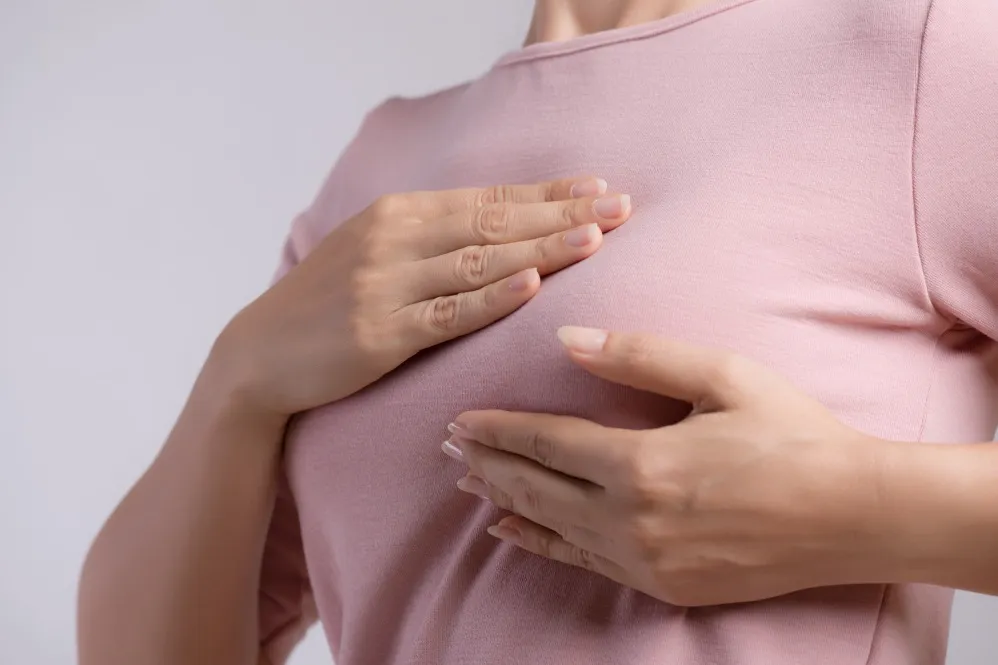
Finding a breast lump can be worrying, but a lump does not automatically mean cancer. Cysts, fibroadenomas, infections and hormonal changes can also cause breast abnormalities. The safest approach is to obtain a structured assessment instead of trying to identify the lump by touch alone.
Dr. Vipul Nandu evaluates patients seeking breast lump treatment in Goregaon and guides them through the investigations needed to establish a diagnosis. Treatment should only be planned after the nature of the lump is understood.
Signs That Need Medical Assessment
Any new or unexplained breast lump deserves attention, particularly if it persists beyond a menstrual cycle or changes over time.
Arrange an evaluation if you notice:
- A new lump in the breast or underarm
- A hard or irregular area
- A lump that is increasing in size
- Nipple discharge, particularly if blood-stained
- Nipple inversion that is new
- Dimpling or puckering of breast skin
- Persistent breast redness or swelling
- Changes in breast shape
- A non-healing sore on the nipple or breast
Painful lumps can be benign, while some significant lumps may be painless. Pain alone cannot determine whether a breast change is serious.
What Does a Complete Breast Lump Assessment Include?
A reliable evaluation commonly combines three elements:
- Clinical examination: The doctor assesses the lump’s size, location, texture and mobility. Both breasts and the lymph nodes under the arms may be examined.
- Breast imaging: Ultrasound, mammography or both may be recommended according to age, symptoms and clinical findings.
- Tissue sampling: Fine-needle aspiration or core biopsy may be needed when imaging cannot confirm the diagnosis.
Not every patient requires every investigation. However, when clinical findings and imaging do not agree, further evaluation is important.
Questions to Ask Before Choosing Treatment
Patients comparing options for breast lump treatment in Goregaon can ask:
- What is the likely type of lump?
- Does it require imaging or biopsy?
- Are the examination and scan findings consistent?
- Can the lump be monitored safely?
- What changes should prompt earlier review?
- If removal is recommended, why is it necessary?
- Will the removed tissue undergo laboratory examination?
A clear explanation of the diagnosis should come before discussion of surgery.
When Can a Breast Lump Be Monitored?
A lump confirmed as benign may sometimes be observed with follow-up examinations or imaging. Monitoring may be considered when it is small, stable and not causing significant symptoms.
Removal may be discussed when a benign lump:
- Continues to enlarge
- Causes pain or discomfort
- Distorts the breast
- Produces uncertainty after testing
- Creates persistent anxiety
- Has features requiring tissue diagnosis
The decision should consider both medical findings and the patient’s preferences.
Preparing for a Breast Consultation in Goregaon
Bring previous mammograms, ultrasounds, biopsy reports and details of breast conditions in close relatives. Note when the lump was first noticed and whether it changes with the menstrual cycle.
Patients from Goregaon and nearby western Mumbai areas should avoid applying creams or repeatedly pressing the lump before assessment. Neither action clarifies the diagnosis and repeated checking can increase soreness and anxiety.
When Prompt Evaluation Matters
Seek timely care if a breast lump appears with skin dimpling, bloody nipple discharge, underarm swelling or rapid enlargement. Breast redness with fever may indicate an infection requiring treatment.
An appropriate provider should offer a step-by-step diagnostic plan rather than making assumptions based only on age or symptoms. For a structured breast lump assessment in Goregaon, schedule a consultation with Dr. Vipul Nandu and carry all available imaging and medical records.
Keywords