A diabetic foot operation begins long before the first incision: clinicians must establish how deep the wound is, whether infection or poor blood flow threatens healing, and how much tissue can be preserved. You will learn how assessment leads to a treatment choice, what happens before and during surgery, and how wound care, pressure relief and follow-up shape diabetic foot surgery recovery.
Key takeaways
- Assess wound depth, infection and blood flow before choosing surgery.
- Review blood-thinning medicines, diabetes control and anaesthesia before the operation.
- Debridement removes dead tissue; amputation is considered when tissue cannot be saved.
- Follow weight-bearing and dressing instructions, and report worsening redness or fever promptly.
How the wound is assessed and the treatment decision is made
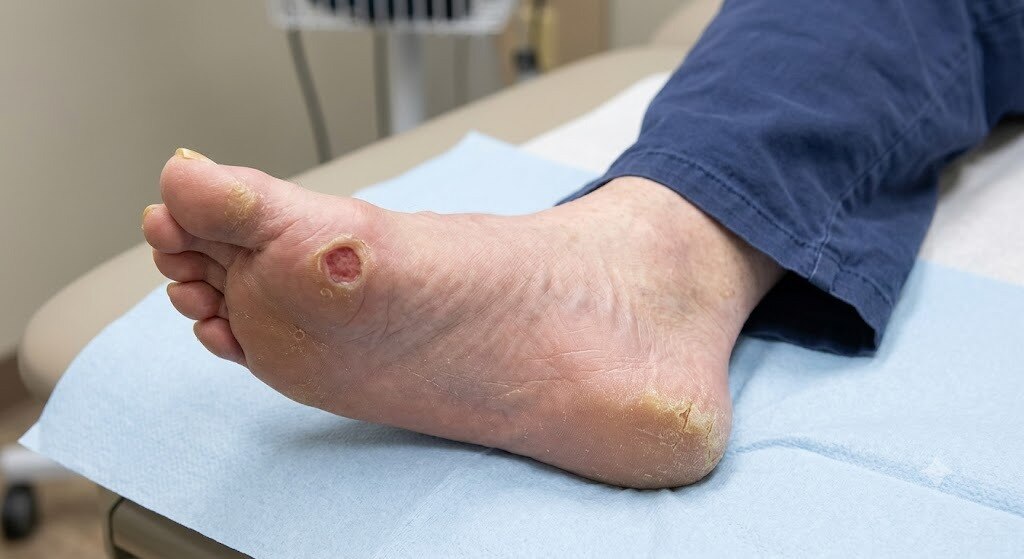
The decision to proceed with diabetic foot wound surgery starts with a structured assessment, not with amputation as the default. The clinician establishes how deep the wound is, whether infection has spread, and whether the foot can heal.
1. The history covers diabetes control, previous ulcers or operations, smoking, pain, fever, walking ability and current medicines. The examination records wound length, width and depth, takes a photograph, tests sensation with a 10-g monofilament, checks pulses and looks for cellulitis, swelling, drainage, abscess, gangrene or exposed bone.
2. A probe-to-bone test helps assess possible osteomyelitis. Plain foot X-rays can show gas, bone destruction, a foreign body or deformity; MRI is considered when bone or deep-tissue infection remains uncertain after examination and X-ray.
3. Blood flow is checked before choosing treatment. An ankle-brachial index can read falsely high when arteries are calcified, so toe pressure, toe-brachial index, Doppler waveforms or vascular imaging may be needed. Significant ischemia can require revascularisation before or alongside wound treatment.
The result may be off-loading, dressings, antibiotics, drainage, debridement or diabetic control rather than an operation. Surgery becomes more likely when dead tissue, an abscess, uncontrolled infection, infected bone or non-viable tissue cannot be managed safely without removal.
A coordinated team also plans footwear, pressure relief, vascular review, glucose management and rehabilitation; removing infected tissue does not correct the pressure or neuropathy that caused the ulcer.
Preparing for surgery: blood flow, medicines and anaesthesia
Your preparation affects what happens during diabetic foot surgery: poor blood flow or uncontrolled glucose can turn a technically successful operation into an unhealed wound.
1. The team checks circulation with pedal pulses, Doppler waveforms, ankle-brachial index and, when vessels are calcified, toe pressure or toe-brachial index. Duplex ultrasound or angiography may follow. If an artery is severely narrowed, angioplasty, a stent or bypass may be needed before or alongside foot surgery.
2. Review insulin, tablets, blood thinners and other medicines with the surgical and diabetes teams. They will give you a specific plan for fasting and diabetes medicines; do not stop aspirin, clopidogrel or an anticoagulant without instruction.
3. Antibiotics treat clinical infection, not an open ulcer or a positive surface swab. If infection is present, cleansing and debridement followed by a deep tissue sample gives a more useful culture.
4. Expect checks of glucose, kidney function, heart risk and infection severity. Agree on what happens to your weight-bearing, dressings and offloading after surgery; removing infected bone does not remove pressure that caused a plantar ulcer.
Anaesthesia determines what you feel and remember:
| Option | What you experience | Typical use |
|---|---|---|
| Local | The foot becomes numb while you remain awake. | A small procedure |
| Regional | An injection numbs the leg; you remain awake or lightly sedated. | Larger foot operations |
| General | You are unconscious and monitored throughout. | Extensive or complex surgery |
The diabetic foot operation steps, from debridement to amputation
The diabetic foot operation steps begin with a fresh inspection, not an automatic amputation. Under the planned anaesthetic, the surgeon probes the wound, identifies its depth and checks which tissue is viable. A superficial swab is less reliable; after cleansing and debridement, deep tissue is sent for culture when infection is suspected.
1. The surgeon removes dead, contaminated or infected skin, fat and muscle until bleeding, healthy tissue remains. This may make the wound look larger, because hidden infection must be cleared rather than covered.
2. An abscess is opened and drained. Pus-filled spaces, sinus tracks and pockets beneath the ulcer are explored so infection is not sealed inside.
3. If infection has reached bone, the surgeon removes the affected bone while preserving useful foot length where possible. Bone samples can be sent for testing.
4. A limited amputation removes only nonviable or irreversibly infected tissue, such as a toe or part of the forefoot. A more proximal amputation is considered when infection, gangrene or poor blood flow makes preservation unsafe.
What happens during diabetic foot surgery determines how the wound is managed afterwards. A clean, well-perfused wound with little tension may be closed with sutures, while an infected or swollen wound is usually left open for drainage and repeat dressing changes.
The surgeon may plan delayed closure, negative-pressure therapy, a skin graft or a flap after infection settles and blood flow is adequate. Dressings protect the site while pressure relief, glucose control and vascular review support healing.
Diabetic foot surgery recovery: weight-bearing, dressings and warning signs
Immediately after surgery, your foot is covered with a sterile dressing, elevated, and checked for bleeding, colour, warmth and sensation. The surgical team sets a weight-bearing limit: you may need complete non-weight-bearing with crutches, a walker or a wheelchair, or protected walking in a cast or postoperative shoe.
Follow that instruction exactly; walking too early can split the wound or expose repaired bone.
Keep the dressing dry and intact until the scheduled review unless the team gives different instructions. Do not soak the foot or apply antiseptic, powder or cream without approval. Follow the glucose plan, take prescribed antibiotics only as directed, and attend wound reviews.
Offloading remains central to diabetic foot surgery recovery; a non-removable knee-high device is first-choice for a neuropathic plantar ulcer when safe, while footwear, casting or another device may suit your operation.
Contact the surgical team urgently for:
- Increasing redness, warmth, swelling or pain
- Pus, a foul smell, spreading drainage or wound separation
- Fever, chills, confusion or rapidly worsening weakness
- Blackened skin, a cold or pale foot, or newly absent sensation
Recovery length and difficulty depend on the wound’s size and depth, infected tissue or bone removed, blood flow, glucose control, neuropathy, deformity and the pressure placed on the area. An open wound, poor circulation or amputation usually requires more dressing care and rehabilitation than a small closed incision.
A healed incision does not remove the risk of another ulcer.
Choosing coordinated diabetic foot care in Mumbai
Judge a diabetic foot surgeon in Mumbai by the pathway they can organise, not by the operation they advertise. Ask who handles circulation testing, infection diagnosis, glucose coordination, pressure relief and rehabilitation before you consent to surgery.
- Who checks pulses and blood flow, and arranges Doppler ultrasound, ankle-brachial index testing or vascular referral when needed?
- Who obtains a deep tissue or bone specimen after cleansing and debridement when infection is suspected, instead of relying on a superficial swab?
- Who provides the offloading plan, dressing schedule, glucose coordination, footwear advice and review of the other foot?
- What happens if the wound needs drainage, repeat debridement, vascular treatment or a limited amputation?
Dr Vipul Nandu is worth assessing against these questions because the useful measure is whether surgical planning connects with wound and follow-up decisions, rather than treating the incision as the endpoint.
| Service feature | What it demonstrates | Why it matters |
|---|---|---|
| Named vascular pathway | Blood-flow assessment and referral are available | Ischaemia can prevent healing after otherwise adequate surgery |
| Infection plan | Clinical diagnosis, deep sampling and targeted treatment | A positive surface culture alone does not prove infection |
| Offloading and footwear | A device, cast or postoperative shoe is prescribed | Removing infected tissue does not remove harmful pressure |
| Scheduled reviews | Wound, glucose, circulation and rehabilitation checks continue | Diabetic foot surgery recovery can fail when recurrence risks go unaddressed |
Related service
Diabetic Foot Surgery Diabetic foot surgery is a specialized surgical procedure aimed at treating complications of diabetes that affect the feet. View service → |
Frequently asked questions
How is a diabetic foot wound assessed before surgery?
The clinician checks wound depth, infection spread, blood flow and whether the foot has enough healing potential.
What happens during diabetic foot surgery?
The operation may include debridement to remove dead or infected tissue, with amputation considered when damaged tissue cannot be preserved.
What is diabetic foot surgery recovery like?
Recovery depends on the procedure and includes planned weight-bearing, dressing changes, diabetes management and monitoring for complications.
Which warning signs need urgent attention after diabetic foot surgery?
Contact your surgical team promptly for worsening redness, swelling, drainage, fever, increasing pain or a wound that opens.
Keywords