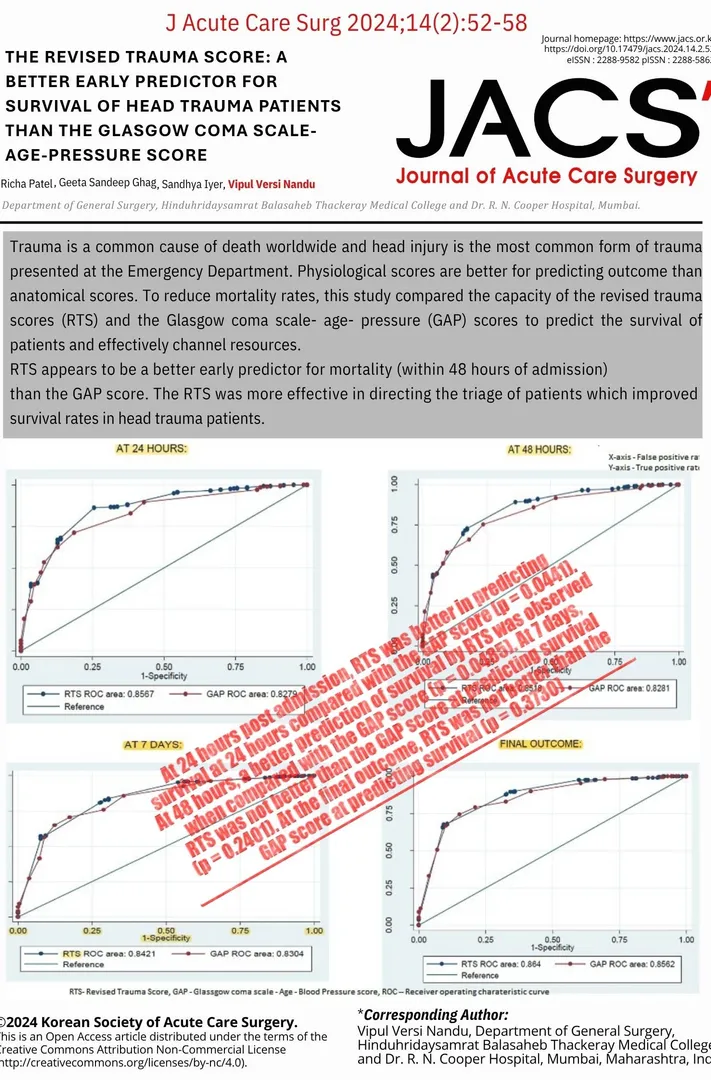
Published and article in Journal of Acute Care Surgery -- a publication of Korean Surgical Society.
The conclusions from the study were
1. Age is an important factor for head trauma; younger patients are more likely to suffer from trauma but are stronger and more likely to survive. Elderly patients have a lower chance of surviving severe head trauma due to the greater incidence of comorbidities and increased likelihood that these patients are physically weaker.
2. RTS is an age-independent useful predictor of in-hospital mortality. It is also a useful tool to assess a patient with traumatic head injury on admission. It also helps to determine a patient’s survival probability which can be used for better preparedness and resource allocation towards patient management in the future.
3. RTS was a better early predictor for mortality (within 48 hours of admission) compared with the GAP score.
The conclusions from the study were
1. Age is an important factor for head trauma; younger patients are more likely to suffer from trauma but are stronger and more likely to survive. Elderly patients have a lower chance of surviving severe head trauma due to the greater incidence of comorbidities and increased likelihood that these patients are physically weaker.
2. RTS is an age-independent useful predictor of in-hospital mortality. It is also a useful tool to assess a patient with traumatic head injury on admission. It also helps to determine a patient’s survival probability which can be used for better preparedness and resource allocation towards patient management in the future.
3. RTS was a better early predictor for mortality (within 48 hours of admission) compared with the GAP score.
Keywords