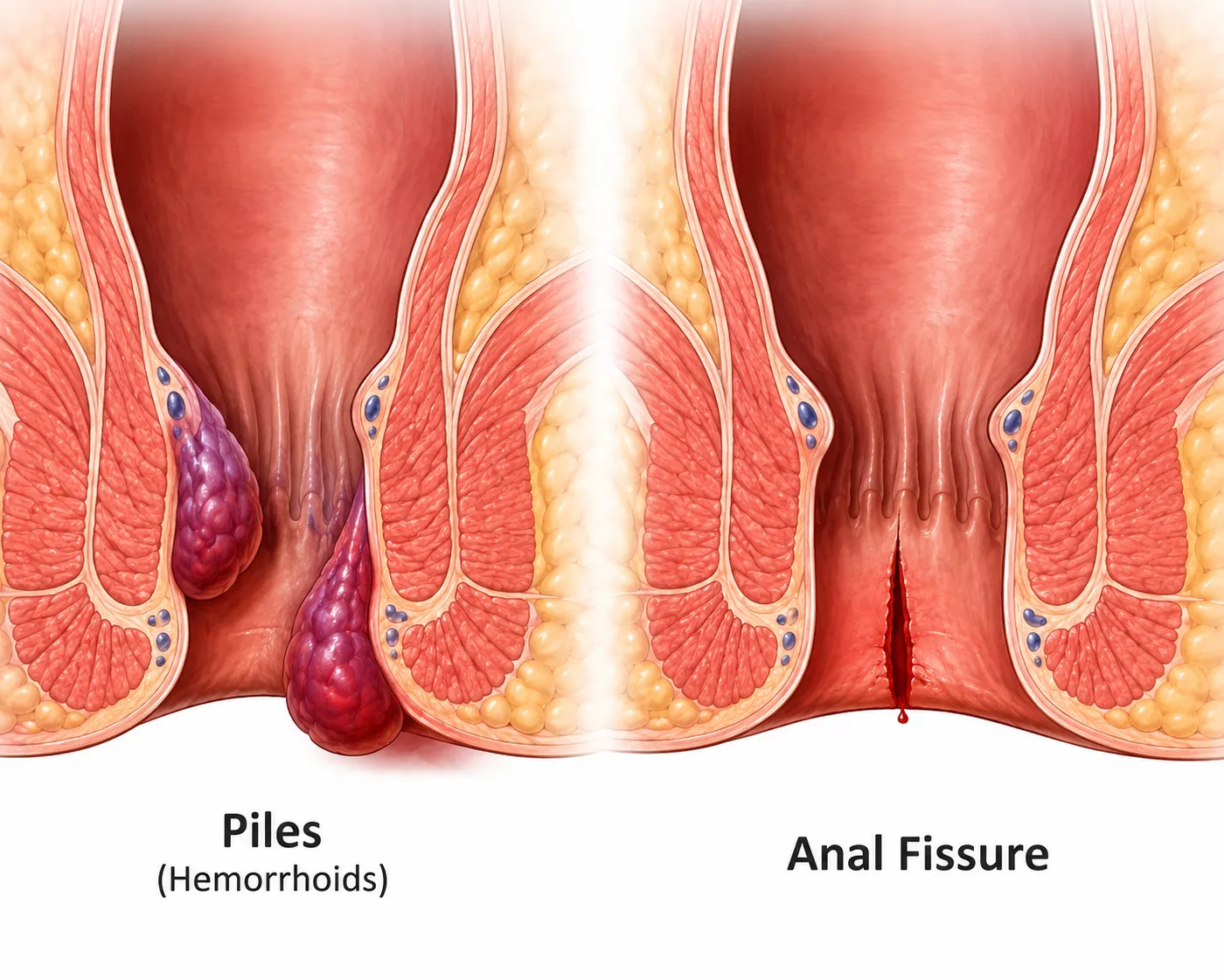
Pain or bleeding during bowel movements is commonly attributed to piles, but haemorrhoids are not the only possible cause. Anal fissures can produce similar complaints, and treatment differs depending on the actual diagnosis.
Understanding the typical differences between piles and fissure can help patients know why a clinical examination may be necessary.
Piles, also called haemorrhoids, are enlarged vascular cushions in or around the anal canal. Internal haemorrhoids commonly cause painless bright-red bleeding, although prolapsing or external haemorrhoids can cause discomfort.
An anal fissure is a small tear in the lining of the anal canal. It typically causes sharp or burning pain during bowel movements, which may continue for some time afterward.
Symptoms commonly associated with piles
Patients may notice:
- Bright-red bleeding after passing stool
- A lump or swelling around the anus
- Tissue coming out during bowel movements
- Itching or irritation
- Mucus discharge in some cases
Symptoms commonly associated with a fissure
A fissure is more likely to cause:
- Sharp pain while passing stool
- Burning pain continuing afterward
- Small amounts of bright-red blood
- Fear of bowel movements because of pain
- A history of constipation or hard stools
These patterns are helpful but cannot reliably replace an examination.
Why is correct diagnosis important?
Repeatedly using over-the-counter piles creams for every episode of rectal bleeding can delay appropriate treatment. Bleeding from the rectum can have several causes, and persistent or recurrent bleeding should be properly assessed.
Early-stage piles may sometimes be managed with dietary changes, adequate fluids, avoiding excessive straining and other conservative measures. A fissure may also respond to measures that keep stools soft along with prescribed medication.
Persistent, advanced or recurrent problems may require additional procedures or surgery depending on the diagnosis.
For patients in Goregaon, Mumbai, Dr Vipul Nandu evaluates anorectal complaints such as piles and fissures and discusses treatment according to the condition and its severity.
People sometimes delay consultation because anal symptoms can feel uncomfortable to discuss. Yet differentiating a fissure from haemorrhoids is usually an important first step toward selecting appropriate treatment.
If bleeding is recurrent, pain is severe, a lump persists or symptoms do not improve with basic measures, evaluation becomes particularly useful. Treatment should address the diagnosed condition rather than the assumption that every episode of anal pain or bleeding is piles.
Keywords